
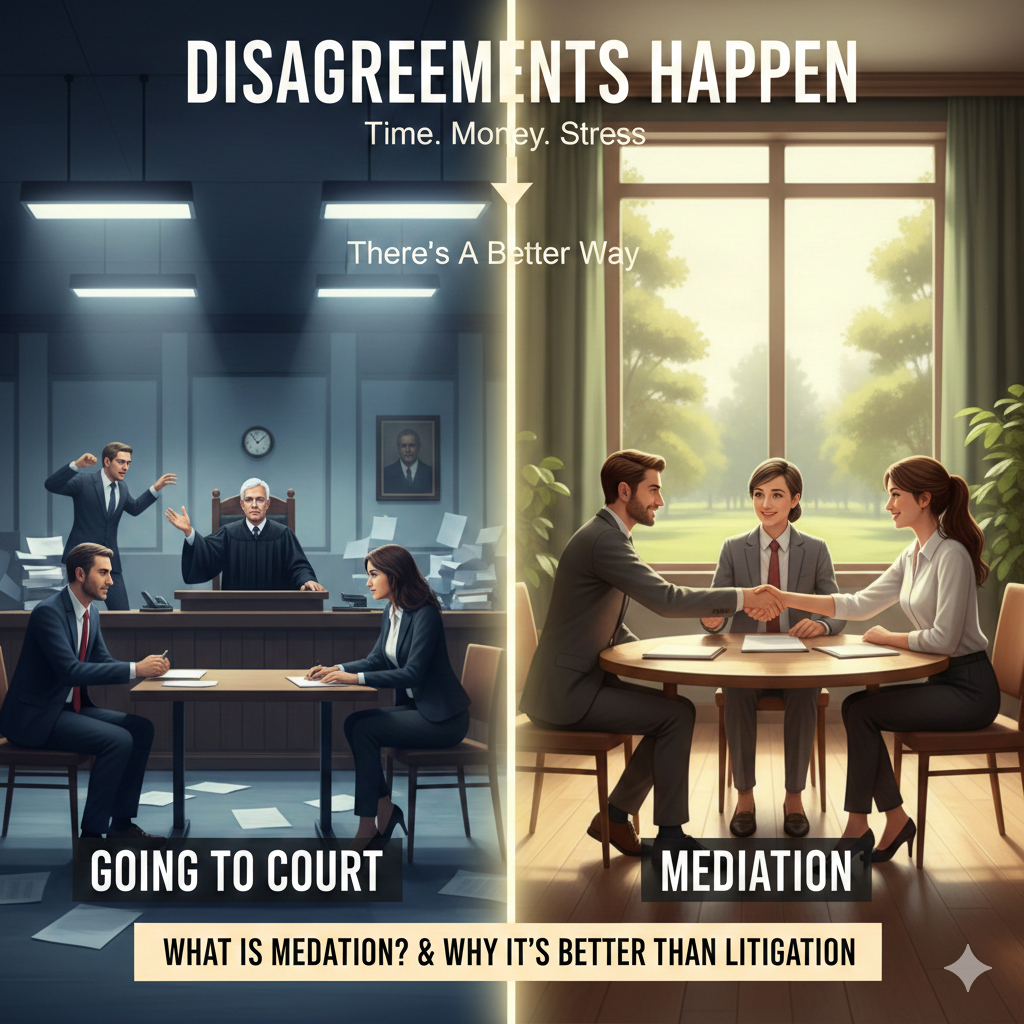
Disagreements happen. Whether it’s a business dispute, an insurance claim, a contract issue, or a personal conflict, situations can quickly escalate. Many people assume the only solution is to “take it to court.”
But going to court isn’t always the best — or smartest — option.
There’s another path that can save time, money, and stress: mediation.
Let’s break down what mediation really is and why so many individuals and businesses choose it over litigation.
What Is Mediation?
Mediation is a structured process where a neutral third party — called a mediator — helps two sides work toward a mutually acceptable agreement.
The key difference?
The mediator does not make the decision.
Instead, the mediator guides the conversation, keeps things productive, and helps both parties explore solutions. The final agreement comes from the people involved — not a judge.
It’s private.
It’s confidential.
And it focuses on resolution, not confrontation.
Why Mediation Is Often Better Than Court
1. It Saves Money
Court cases can become expensive very quickly. Filing fees, attorney fees, preparation time, and multiple court appearances all add up.
Mediation is typically far more cost-effective. It reduces legal expenses and avoids the drawn-out process that often comes with litigation.
2. It Saves Time
Court schedules can stretch cases out for months — sometimes even years. Delays, hearings, and procedural steps slow everything down.
Mediation can often be scheduled much faster. Many disputes are resolved in a matter of sessions rather than months of waiting.
3. It’s Confidential
Court proceedings are public record. That means sensitive business details or personal matters may become accessible to others.
Mediation is private. What is discussed in the room stays in the room. For businesses and individuals who value discretion, this is a major advantage.
4. It Reduces Stress
Litigation can be adversarial and emotionally draining. The courtroom environment can increase tension and make communication harder.
Mediation creates a more controlled and respectful setting. It encourages calm discussion and practical solutions rather than escalating conflict.
5. It Preserves Relationships
In many disputes — especially business, family, or ongoing professional matters — the relationship doesn’t simply disappear after the disagreement.
Court battles often damage relationships beyond repair.
Mediation focuses on cooperation and understanding, which can help preserve professional or personal connections moving forward.
6. You Stay in Control
In court, a judge makes the final decision. Once the ruling is issued, both parties must accept it — whether they agree with it or not.
In mediation, the outcome is shaped by the people involved. That level of control often leads to more practical solutions and higher satisfaction on both sides.
When Is Mediation a Good Option?
Mediation works best when:
- Both parties are open to discussion
- A faster resolution is preferred
- Privacy is important
- Maintaining a professional or personal relationship matters
- There’s interest in finding a balanced solution rather than “winning”
Final Thoughts
Going to court isn’t always the only answer — and often, it isn’t the best one.
Mediation offers a smarter approach:
Less expense.
Less delay.
Less hostility.
More control.
For individuals and businesses looking for efficient, fair, and professional dispute resolution, mediation provides a practical path forward.