
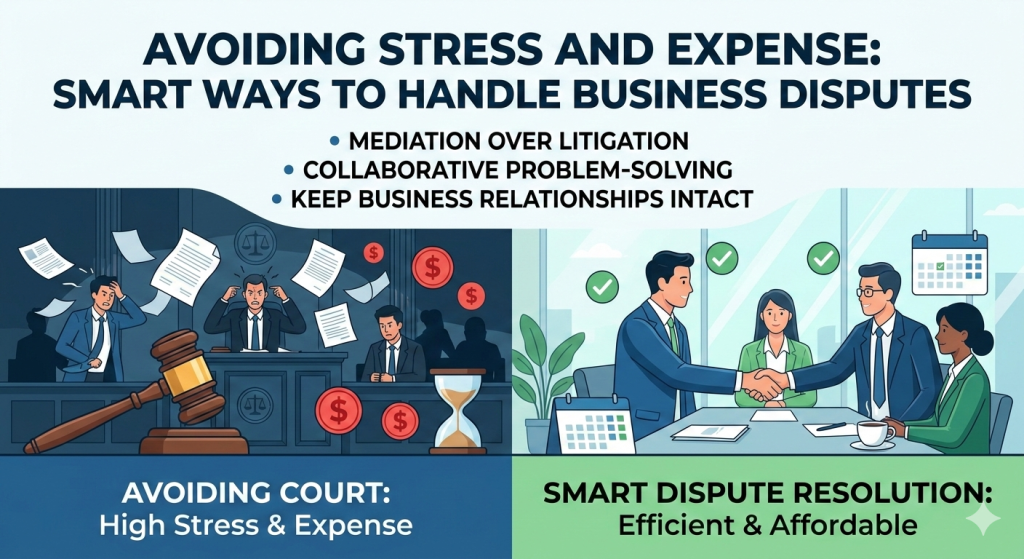
In business, disagreements are almost inevitable. A delayed payment. A broken contract. A misunderstanding between partners. A vendor who didn’t deliver as promised.
The real question isn’t “Will a dispute happen?”
It’s “How will you handle it?”
Too many business owners jump straight to court, believing it’s the only way to protect their rights. But litigation often brings months — sometimes years — of stress, high legal fees, damaged relationships, and public exposure.
Why Traditional Litigation Isn’t Always the Best First Step
Going to court can feel powerful. But here’s what most entrepreneurs don’t see at the beginning:
- Legal fees add up quickly
- Cases can take months or years
- Outcomes are unpredictable
- Relationships are often permanently damaged
- Proceedings become part of public record
For growing businesses, that’s a heavy burden.
Instead of reacting emotionally, successful business leaders pause — and choose a smarter strategy.
1. Start With Calm Communication
Before lawyers get involved, open a structured conversation.
Many disputes escalate simply because:
- Expectations weren’t clearly discussed
- Emotions overshadowed logic
- Assumptions replaced facts
2. Use Mediation: A Cost-Effective Solution
One of the most powerful tools in business conflict resolution is mediation.
With mediation:
- A neutral third party guides discussion
- Both sides remain in control of the outcome
- The process is confidential
- It’s significantly faster than court
- Costs are far lower than litigation
Organizations like MRM Mediators & Arbitrators help businesses resolve disputes professionally while preserving working relationships.
3. Consider Arbitration for Binding Decisions
When parties want a final decision without going to court, arbitration is a strong alternative.
Arbitration:
- Is private
- Is faster than litigation
- Usually costs less
- Results in a binding decision
Many contracts today include arbitration clauses because companies understand the long-term savings in time and money.
4. Strengthen Contracts Before Problems Arise
The best dispute resolution strategy? Prevention.
Strong contracts should include:
- Clear payment terms
- Defined deliverables
- Deadlines
- Termination clauses
- Dispute resolution clauses (mediation or arbitration first)
5. Protect Business Relationships
Not every disagreement needs to end a partnership.
Smart leaders ask:
- Is this a misunderstanding or misconduct?
- Can the relationship be repaired?
- What’s the long-term value of this partnership?
Litigation often destroys business relationships. Mediation, on the other hand, can strengthen communication and rebuild trust.
6. Evaluate the Real Cost — Not Just Legal Fees
When considering how to resolve a dispute, think beyond attorney bills.
Ask yourself:
- How much time will this take away from running my business?
- What stress will this create for my team?
- Will this affect my reputation?
- Is this worth the emotional drain?
Time is money. Focus is money. Peace of mind is priceless.
7. Act Early — Not Emotionally
The longer a conflict lingers, the more expensive it becomes.
Early intervention:
- Reduces escalation
- Preserves evidence
- Opens communication
- Prevents reputational damage
Reacting out of anger can cost thousands. Responding strategically can save tens of thousands.
Final Thoughts
Business disputes don’t have to become financial disasters.
The smartest companies don’t rush to court. They:
- Communicate early
- Use mediation
- Consider arbitration
- Strengthen contracts
- Focus on long-term growth
Because at the end of the day, your goal isn’t to “win a fight.”
Your goal is to protect your business, your peace, and your future.
Frequently Asked Questions (FAQs)
Mediation itself is not binding unless both parties sign a settlement agreement at the end of the process.
Yes. In most cases, arbitration decisions are legally binding and enforceable in court.
Mediation is generally less expensive because it focuses on negotiation rather than a formal hearing process.
Many mediation cases resolve in one day or a few sessions, depending on complexity.
Yes. Many disputes begin with mediation. If no agreement is reached, arbitration can be pursued.