
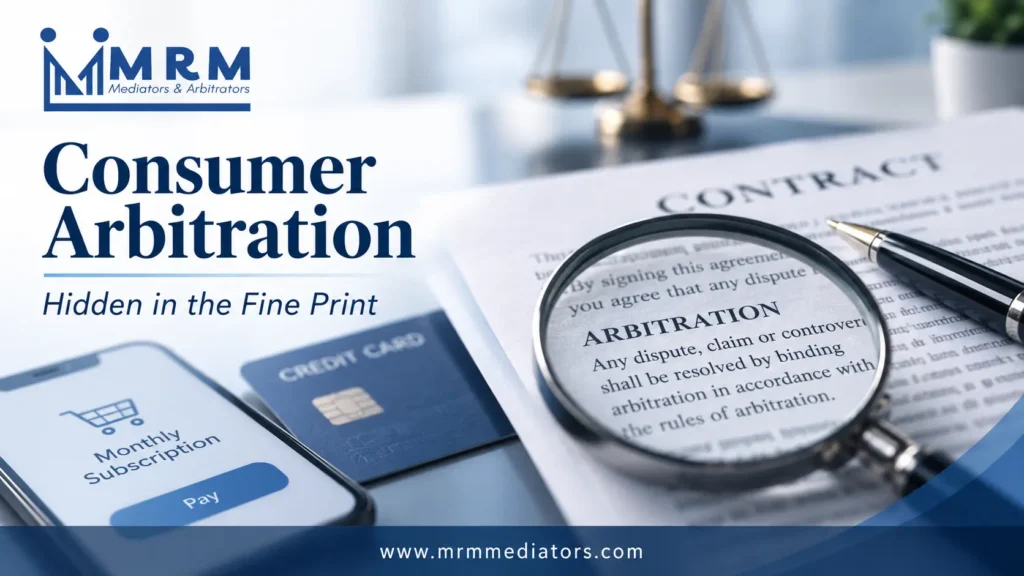
Consumer Arbitration- The Clause You Already Signed Without Knowing It
If you have a credit card, a phone plan, a streaming subscription, or a checking account, there’s a good chance you’ve already agreed to something you never actually read: a clause that takes away your right to sue that company in court.
Most people find out the hard way — after something goes wrong, when a lawyer tells them their only option is arbitration, not a lawsuit.
What Consumer Arbitration Actually Is
Consumer arbitration is a private dispute resolution process where a neutral third party — not a judge or jury — decides your claim against a company. It sounds neutral in theory. In practice, it usually shows up as a mandatory clause buried deep in the terms and conditions of a service you signed up for, often without any real negotiation involved. Click “I agree,” and you’ve likely accepted it.
These clauses show up almost everywhere:
credit card agreements, phone contracts, checking accounts, investment platforms, even some employment and service agreements. The vast majority of people who are bound by one have no idea it exists until they try to file a complaint and discover court isn’t an option.
What You Actually Lose When You’re Bound by One
This is the part that catches people off guard. A forced arbitration clause typically blocks you from suing the company in court, prevents you from joining a class action with other affected customers, and limits your ability to appeal the outcome — even if the arbitrator gets it wrong. The company, not you, often selects the arbitrator. And unlike a judge, that arbitrator isn’t require to follow legal precedent the way a court would.
None of this means arbitration is automatically unfair in every case — but it does mean you’re playing a different game than you might expect,
with rules mostly written by the company on the other side.
Can You Actually Challenge an Arbitration Clause?
Yes, in certain situations. The Federal Arbitration Act governs most of these agreements, but it doesn’t make every clause automatically enforceable. A few common ways a clause can be challenge-
- Unconscionability — if the clause was present as take-it-or-leave-it, buried in fine print, or contains one-sided terms that make it nearly impossible to bring a real claim, a court may find it unenforceable.
- Lack of proper notice — if you weren’t given clear notice that you were agreeing to arbitration, or the agreement wasn’t properly formed, the clause itself can be challenged.
- Opt-out rights — some contracts actually include a window (often 30 to 60 days) to formally opt out of the arbitration clause in writing. Almost nobody uses this right, mostly because almost nobody knows it exists.
How to Find Out If You’re Already Bound by One
Before a dispute happens, it’s worth checking. Pull up the terms and conditions for your credit card, phone provider, or any subscription service and search for “arbitration,” “dispute resolution,” or “binding arbitration.” If you find one and it’s within the opt-out window, you may still have a limited-time option to decline it in writing.
If a dispute has already come up and you’re being told arbitration is your only path, that’s the moment to have someone review whether the clause is actually enforceable — not assume it automatically is.
Already Facing a Consumer Arbitration Claim?
Whether a company is pointing you toward arbitration or you’re trying to understand what rights you still have, getting the clause review before you proceed can make a real difference in the outcome.
FAQs About Consumer Arbitration
1.What is a forced arbitration clause?
It’s a mandatory provision in a contract requiring disputes to be resolved through private arbitration instead of a lawsuit — often buried in the fine print of credit card, phone, or subscription agreements.
2.Can I sue instead of going to arbitration?
Usually not, if you’re bound by a valid arbitration clause. However, the clause itself can sometimes be challenged and found unenforceable depending on how it was presented and worded.
3.Do arbitration clauses block class action lawsuits?
Yes, most forced arbitration clauses include a class action waiver, meaning you can only pursue your claim individually, not as part of a group lawsuit.
4.Is there a way to opt out of an arbitration clause?
Some contracts include a limited-time opt-out window, typically 30 to 60 days from signing, that lets you formally decline the arbitration clause in writing.
5.What makes an arbitration clause unenforceable?
Clauses can be challenge as unconscionable if they were presented unfairly, buried in fine print, or contain one-sided terms — or if there was a failure to properly notify you of the agreement.